GHK-Cu
What Is GHK-Cu? Structure, Origin And Research Areas
GHK-Cu is the copper complex of the tripeptide glycyl-L-histidyl-L-lysine. Its structure, its discovery in human plasma, and the research areas it appears in.
- Forbidden Labs
- November 21, 2026
- 2 min read
GHK-Cu is the copper(II) complex of GHK, the tripeptide glycyl-L-histidyl-L-lysine. It is one of the most cited small peptides in the research literature, first described in 1973 and studied since across cell culture and animal models. This note covers its structure, its origin and the research areas it appears in. It is written for laboratory buyers and makes no statement about the use or effects of the compound.
Structure And Chemistry
GHK is a tripeptide with the sequence Gly-His-Lys. According to PubChem (CID 73587), the free peptide has the molecular formula C14H24N6O4 and a molecular weight of 340.38 g/mol. GHK binds copper(II) ions with high affinity to form GHK-Cu, the complex most research suppliers list. Because the copper is part of the complex, the expected mass on a mass spectrometry report differs from the mass of the free tripeptide, which is worth checking when you compare a certificate of analysis against the label.
Origin In Plasma And Collagen
A 2018 review by Pickart and Margolina in the International Journal of Molecular Sciences traces GHK to Pickart's 1973 work at the University of California, San Francisco, where it was identified as a small peptide in human plasma. The same review notes that the Gly-His-Lys sequence also occurs in the alpha 2(I) chain of type I collagen, which is one proposed source of the free peptide when that protein is broken down.
The review reports plasma levels of about 200 ng/mL at age 20, falling to about 80 ng/mL by age 60. That decline is one reason the peptide has drawn interest in research on aging biology.
Research Areas
The same review groups published GHK and GHK-Cu work into several areas. These are fields of study, not findings:
- Extracellular matrix and collagen biology
- Tissue repair models
- Angiogenesis
- Gene expression profiling
- Inflammation and oxidative stress pathways
- The ubiquitin proteasome system
Much of the more recent interest comes from gene expression studies, which look at how the complex relates to broad sets of genes rather than a single target.
What To Check On The Documentation
For a copper peptide complex, the certificate of analysis should identify the compound as the copper complex, report an observed mass that matches it, and give the purity method and chromatogram for that specific lot. The current lot report is on the GHK-Cu lab report page, and every compound we list has its own report on the lab reports page.
In The Catalog
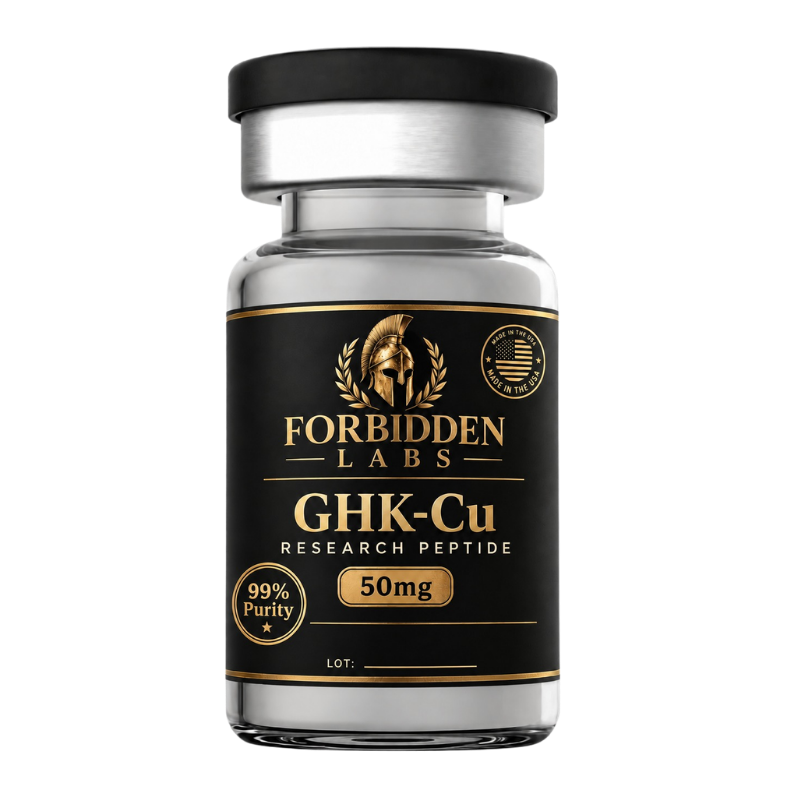
GHK-Cu 10mg sits in our cellular signaling collection next to BPC-157, TB-500 and the Wolverine Stack. Researchers working on aging biology may also look at Epitalon and NAD+ in the mitochondrial biology collection. Browse all compounds, read our research use policy, or apply for a wholesale account. For laboratory research use only.