mots-c
What Is MOTS-c? A Mitochondrial Peptide Explained
MOTS-c is a 16 amino acid peptide encoded in mitochondrial DNA, described in 2015. Its structure, discovery, research areas in laboratory models and what to check on its COA.
- Forbidden Labs
- November 23, 2026
- 3 min read

MOTS-c is a 16 amino acid peptide encoded in the mitochondrial genome, within the 12S rRNA region of mitochondrial DNA. Its name stands for mitochondrial open reading frame of the 12S rRNA-c. It was first described in 2015 and has since been studied in cell and animal models of mitochondrial signaling and metabolism.
This note covers its structure, how it was discovered and the research areas it appears in. It is written for laboratory buyers and makes no statement about the use or effects of the compound in people or animals.
Structure And Chemistry
MOTS-c is a short linear peptide of 16 residues. According to PubChem (CID 146675088), it has the molecular formula C101H152N28O22S2 and a molecular weight of about 2,174.6 g/mol. That expected mass is the figure to compare against the mass spectrometry result on a certificate of analysis. Our GHK-Cu note explains why checking the expected mass against the report matters.
Discovery: A Peptide Encoded In Mitochondrial DNA
Most of the proteins mitochondria use are encoded in the cell nucleus. MOTS-c stood out because it is encoded in the mitochondria's own small genome. In a 2015 paper in Cell Metabolism, Lee and colleagues at the University of Southern California reported a short open reading frame within the mitochondrial 12S rRNA that encodes the 16 amino acid peptide they named MOTS-c. It followed the earlier identification of humanin, another mitochondrial derived peptide, which had suggested that more such peptides might exist.
Research Areas
MOTS-c appears in the literature mainly in these areas, all in laboratory models:
- Mitochondrial to nuclear signaling. A 2018 Cell Metabolism paper by Kim and colleagues reported that MOTS-c translocates to the nucleus and regulates nuclear gene expression in response to metabolic stress in cell models, in an AMPK dependent manner.
- Metabolic regulation. The original 2015 study examined the folate cycle, de novo purine biosynthesis and AMPK activation in cell and mouse models.
- Skeletal muscle and aging research. A 2021 Nature Communications paper by Reynolds and colleagues examined MOTS-c in the context of exercise and age related muscle decline in mouse models and human samples.
Findings in cell culture and animal models do not establish any effect in people, and we make no such claim.
What To Check On A MOTS-c Certificate Of Analysis
- Identity. A mass spectrometry result matching the expected mass of about 2,174.6 g/mol.
- Purity. An HPLC chromatogram and purity percentage.
- Lot and strength. The lot number and strength on the report must match the vial label.
- Laboratory, date and signature. Who ran the test and when.
The current MOTS-c lab report is published for the 10 MG strength, and every compound we list has its report in the lab report library.
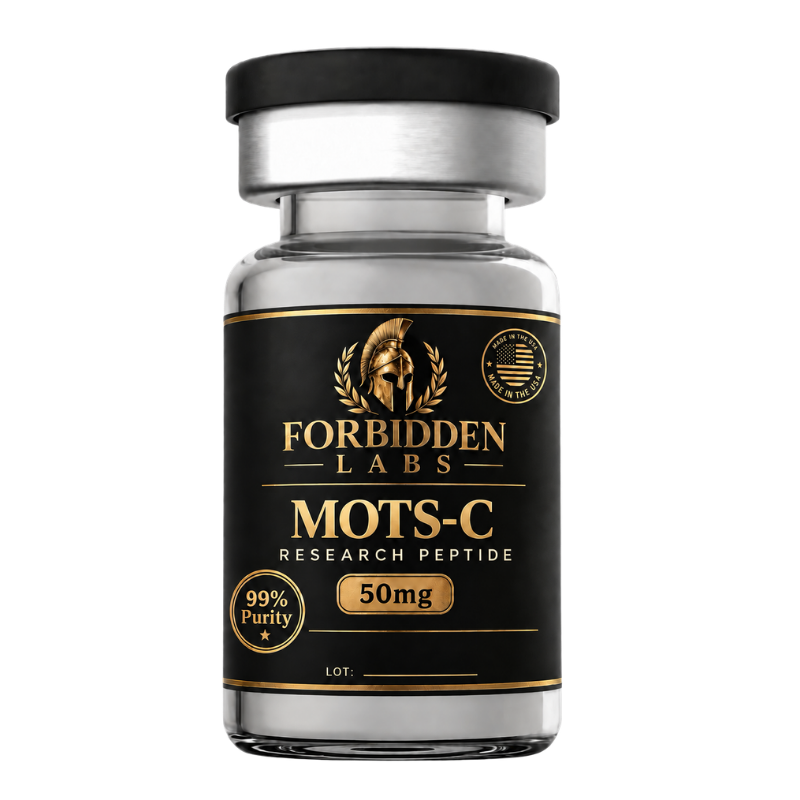
Forbidden Labs MOTS-c
We list MOTS-c at 10 MG per vial in our receptor pharmacology collection, shipped in plain, unbranded parcels. The product page lists storage at 2 to 8 °C. Related compounds include tesamorelin and CJC-1295 plus Ipamorelin in neuroendocrine research.
Research Use Only
All Forbidden Labs products are sold strictly for laboratory research. They are not for human or animal consumption, and nothing in this note is medical advice or guidance on use. See our research use policy.
Sources
- Lee C et al. The mitochondrial-derived peptide MOTS-c promotes metabolic homeostasis and reduces obesity and insulin resistance. Cell Metab. 2015;21(3):443-454.
- Kim KH et al. The Mitochondrial-Encoded Peptide MOTS-c Translocates to the Nucleus to Regulate Nuclear Gene Expression in Response to Metabolic Stress. Cell Metab. 2018;28(3):516-524.
- Reynolds JC et al. MOTS-c is an exercise-induced mitochondrial-encoded regulator of age-dependent physical decline and muscle homeostasis. Nat Commun. 2021;12:470.
- PubChem, MOTS-c (CID 146675088)